Friday, December 4, 2009

All the Single Ladies

Being a single mother is a tough job. Yesterday we received another batch of algae from the helpful folks at Sunnyside Sea Farms. Because our algae is not growing as quickly as we thought it might, we wanted to make sure we have enough to produce the desired effect. So we ordered 4 liters.

These little guys arrived in 4 1L bottles and were highly concentrated. Because the organisms are tropical, there was some concern in having them delivered to our 38ยบ Michigan weather. When the bottles arrived they were quite cold, so I rushed home and turned on the heater. Apparently I had underestimated the amount of algae we were actually receiving. This sounds dumb because I knew we had ordered 4L.... but I hadn't thought about the amount of space they needed. Before the arrival I had prepared 4 2L bottles half full with salt water (specific gravity 1.019). When I added the algae to the bottles they were full. Hmm. I don't think this is good.

Tonight I am going to prepare 4 more 2L bottles and spread the guys out a bit. Just having the algae in my room stresses me out. I'm sure that I have done everything to take care of them, but the more we have the harder it gets. And we just asked John Marshall to order us 3-4 more liters! AHHHH! This is definitely becoming a two person job. We want to make sure we have enough algae to really wow the crowd, but we don't want to have too much to take care of.

Monday, November 30, 2009

IV Bags and Pumps


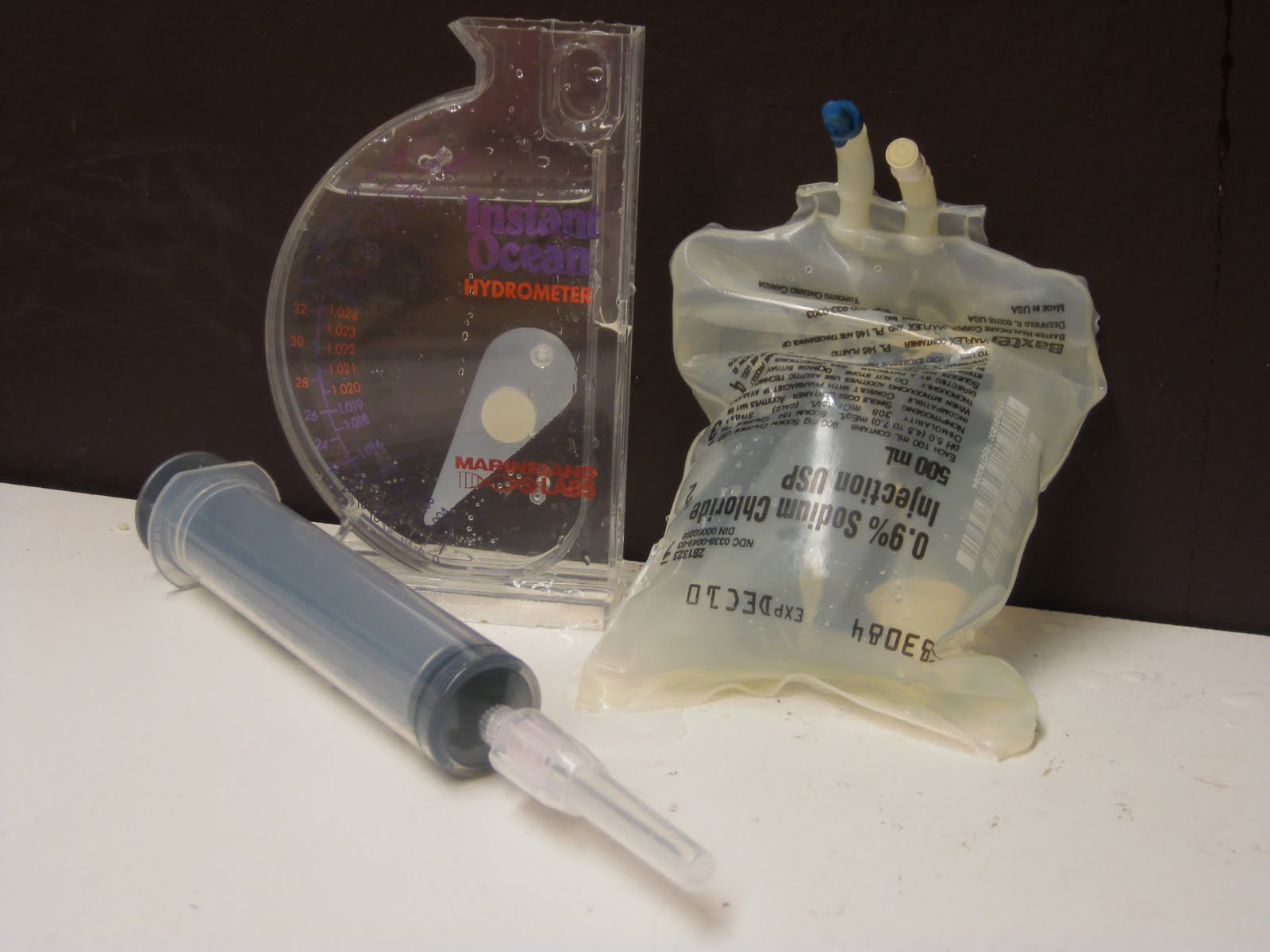
Specific gravity of saline solution=1.008. Specific gravity needed for algae=1.019. Translation: we must empty all of the IV bags, mix a new batch of sea water solution, and then get that solution and the algae back into the bags.

So far we are optimistic. During a brief meeting we ran some tests with the pump we currently have. For our final piece we have ordered a pump with four out puts, rather than one. We plan to create a system of tubes and splitters in order to spread bubbles throughout our algae array.

Pump/IV bag test:

Though very exciting, the only real success here was fitting the two tubes together. If this were to continue much longer, the bag would be full of air and we would have to squeeze it out like you see in the beginning of the video.

To fix this problem we snipped the tip of off the other tube and stuck more tubing through until it reached the air at the top of the bag.


The curvaceous nature of the tubing caused us a little bit of worry. In order to keep it from moving back into the solution we added a coffee straw into the middle of the tubing.


Next, we need to get the splitters into action and see if we can get bubbles flowing through a series of bags. Until then I will be making preparations for the arrival of the algae. The rigid Michigan weather may prove a threat to our tropical friends, we will soon see. Also, we need not forgot that in the gallery we will need a way to keep the algae in darkness for a twelve hour cycle.

Our panels will be cut later this week at which time we will have the information needed to complete our motorized moving mechanism.

The count down continues!

Sunday, November 29, 2009

Pulleys and Release Mechanisms

We needed to make some progress with our form, so we whipped together a quick cardboard prototype. At first we were testing movement by swinging them against each other, side to side. This looked unintentional and was rather impossible to control. Prof. John Marshall mentioned that the duality in the form looked like a joint, and suggested that we explore the movement in terms of this interpretation. By rigging up a pulley system with string and human power we began exploring this idea.


This worked great, but the system needs to be self contained. Ideas were thrown around, winches, spools, gears, releasing mechanisms.... and we came up with this:


By shaving off part of the gear, we were able to create a release mechanism. When the larger gear (connected to the panel) came in contact with the bare area of the small gear, the weight of the panel will cause the large gear to drop, or release. I drew up a few ways to possibly create smoother movement.

Tuesday, November 17, 2009

Mother Algae

Having received our bioluminescent specimen on Friday November 6th it is about time I give an update. Sunnyside Sea Farms in Santa Barbra, CA sent us over (3) 5mL bags of very beautiful and very delicate Bioluminescent Dinoflagellates, aka Pyrocysts fusiformis, or "Lights from the Sea" which until now we have been calling bioluminescent algae, and most likely will continue to call it such.

I am the fortunate occupant of a very warm bedroom so I took the tropical little guys home with me. After their exciting trip across the country I let the algae rest for a 24 hour cycle, 12 hours of light and 12 hours of dark. Once I felt they had enough time to settle from shipping I gave their bags a little poke. To my delight the specimen were very much alive, and gave off a beautiful blue glow. Immediately I began learning about them. I was able to identify what was algae and what was not(maybe this seems obvious but they are very difficult to see during the day). Poking the bags once more I noticed that they glowed for a shorter period of time. Waiting for longer before the third poke seemed to let them regenerate and they glowed as bright and for as long as the first time.

The specimen held up just fine in their original worlds for a couple days, but we wanted to give them room to grow. In order to do so, I prepared two 2L bottles full of sea-saltwater (specific gravity of 1.019) with a little bit of micro algae grow. Being that it was my fist time dealing with specific gravities and hydrometers I began with a bit of difficulty, but by the second batch I had it figured out pretty well. To help ensure a safe transfer I left the two bottles of saltwater in the same room as the algae for the night (their day) in order to get the solutions to the same room temp, and prevent shock.

I am proud to say that the transfer went swimmingly, and the algae have survived beyond it. At first I was nervous to make the transfer during their night cycle because it meant doing so in the dark. However, everything went well and it was quite a spectacle. As I poured the algae into the new solution they glowed. The stream of glowing algae twisted and twirled as it penetrated the saltwater solution. It was truly beautiful. Unfortunately, I have encountered much difficulty and little to no triumph in my attempts to document the glow of the algae.

Tuesday, November 3, 2009

Becoming Team Slime

Coming to terms with reality, we have redesigned and simplified our approach to the final task. Having only 38 days until the grande finale (thanks to John Marshall for the ticking reminder), and accepting the fact that whatever our product is will exist inside a gallery we have abandoned the algae powered helibot. However, we have not jumped off of the algae train. It was proposed that we farm and harvest algae for combustible biofuel, rather than attempt to extract hydrogen for live fuel. A framework, modules containing algae, and heliotropic surfaces would create a system in which the algae would have maximized potential for growth. Because algae reproduces at a considerable rate, the system would include a dumping mechanism, or means of algae removal. This might involve human interaction. To enhance this interaction and add spectacle, a sensory mechanism will reveal the removal portal when approached.

As with all ideas, this one was met with some hesitation. Admittedly I wanted a little something more. Dumping the algae and taking it to another destination to be burned and used to fuel some unknown thing is not the ideal outcome I had envisioned. There was little disagreement that ideally we would be creating a closed system.

I try to operate under a set of unwritten rules as far as teamwork goes. One of these rules goes that if you are unhappy with a decision or plan to disagree with an idea you should only do so if you are able to articulate what is wrong or bad with what is being proposed, and in turn have an alternative solution or idea. Team 4 addressed the need for this rule in their presentation on Friday. So, being that I wasn't totally happy with the proposal I worked through the rule. I wasn't fully on board with the plan because I felt it lacked closure. Not only is the system somewhat open, but the end is undetermined. Then I had an Aha! moment. During the day (12 hrs of sunlight) bio-luminecent algae produces energy through photosynthesis, and at night (12 hrs of darkness) it glows blue, much like the lights on the emergency phone stations throughout campus.

For sake of prototyping we have requested strains of both green algae (unspecified) and of bio-luminescent algae.

On a side note- only 4 members of the team were present at the time of this proposal... Tomorrow we will see how it is received. I am excited to continue the evolution of our project and even more so to begin developing a physical model.

Saturday, October 31, 2009

Reverse Brainstorming

During Eugene Shteyn's visit we participated in what he calls reverse brainstorming.

These images show the 70 problems we came up with somewhere between 30 and 45 minutes.


My Short Term List: 15, 17, 62, 70, 13, 35, 44, 3, 68, 24

My Long Term List: 65, 59, 58, 1, 18, 42, 45, 46, 20, 28

The teams Top Three:

Short Term: 70, 10/13, 9

Long Term: 20, 28, 59

Then we talked about three important factors of our project, size, time and cost.

Humans have the tendency to make things that are big enough for them to hold, or carry, and often at the size that would be considered "humanscale". This is close to the size I was planning for our robot.

We discussed the possibility of scaling the object down. If there were several very small bots, what would the project be? What if the bot was larger, the size of the city? It could become a bioreactor power plant. A living, breathing, green mass... constantly reproducing and expanding.

Final Task

On the day that Julian Bleecker visited we also received our final task and team.

Requirements:
Project-Each team is required to design, build, program and test a 'heliotropic smartsurface' that makes use of:
  • Solar Energy Harvesting
  • Microcontroller programming (Arduino) and circuit building
  • Parametric modeling (Digital Project)
  • Digital Fabrication

Brainstorm Session #1

Brainstorm Session #2:
  • What are we trying to do?
  • What does it look like?
Smartsurfaces can....
  • Do the job for you
  • Create smoother interface
  • Create dialogue
  • Create characters/fictitious life
  • Create/allow for understanding/education
  • Expand
  • Contract
  • Distort
  • Move
  • React
  • Light up
  • Create shelter
  • Sense (the environment and factors of it)
  • And many more....
So far we've seen surfaces that...
  • track the sun
  • reflect the sun
  • concentrate the sun
  • shade the sun
  • inflate
  • have and aperture (open and close)
  • expand
  • have layers
  • direct the sun
From here we began working on a heliotropic clean water system. It involved an ant farm like structure that exposed a purifying system of layered aggregates. The goal was to provide clean water, either to the public or creating a closed system within a building. Additionally, the transparency of the system would serve as an educational element.

We were quickly deferred from this idea. It became obvious that most groups were suffering because they were not operating within the constraints. The objective is to make a heliotropic smartsurface... not to solve the worlds clean water crisis. Therefore, we went back to the drawing board.

Team Brainstorming Session #3:

From here we moved forward with the working concept of an algae powered "heliobot". Essentially we would be creating a robot containing algae. Through photosynthesis a particular strain of algae, C. reinhardtii, produces hydrogen that would be captured in a fuel cell and used to power the robots movement. More on this strain of algae can be found here.

Getting Down to work....

We seemed to have a hard time getting together over these past two weeks. When talking about group work in class, the professors informed us of the reason we are in teams of 6. Apparently studies have shown that teams of 5 to 6 work better than smaller teams. In groups of 5 to 6 there is more room for subgroups and fresh ideas. This has proven to be true. After having three meetings with 4 or less members present we had not gotten very far.


Finally, with a 5th member present we were able to move forward.
Here Aidan is hard at work on our sketch model robot. We used parts from some sort of erector set and a SmartWater bottle for assembly. The robots front legs, controlled by motors, pull the robot forward, dragging its' wheeled rear-side behind.